Written by: Robert Kiener for New England Home Magazine (nehomemag.com)
For a bigger version of the text, scroll lower.
New England Home Magazine Feature
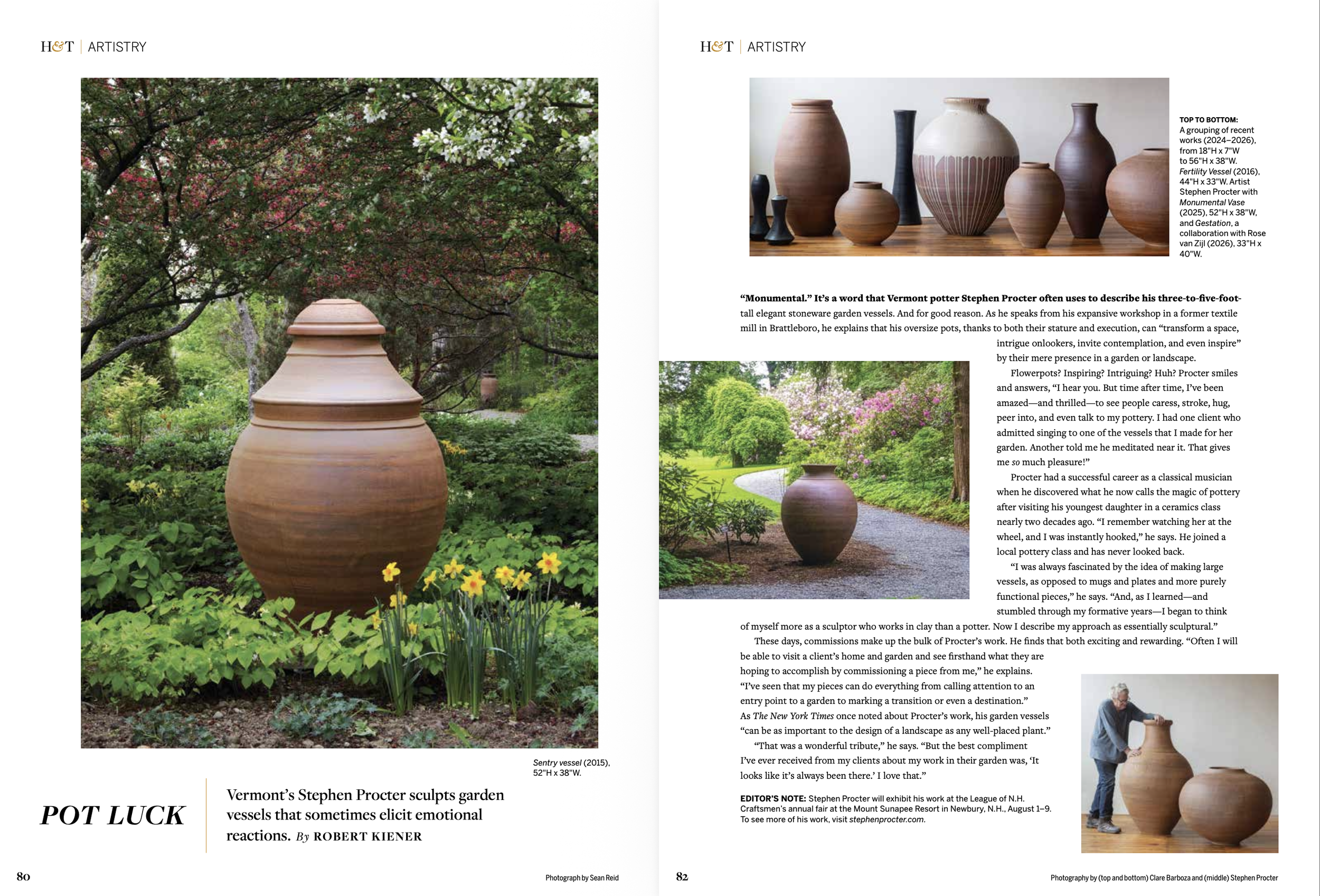
“Monumental.” It’s a word that Vermont potter Stephen Procter often uses to describe his three-to-five-foot- tall elegant stoneware garden vessels. And for good reason. As he speaks from his expansive workshop in a former textile mill in Brattleboro, he explains that his oversize pots, thanks to both their stature and execution, can “transform a space, intrigue onlookers, invite contemplation, and even inspire” by their mere presence in a garden or landscape.
Flowerpots? Inspiring? Intriguing? Huh? Procter smiles and answers, “I hear you. But time after time, I’ve been amazed—and thrilled—to see people caress, stroke, hug, peer into, and even talk to my pottery. I had one client who admitted singing to one of the vessels that I made for her garden. Another told me he meditated near it. That gives me so much pleasure!”
Procter had a successful career as a classical musician when he discovered what he now calls the magic of pottery after visiting his youngest daughter in a ceramics class nearly two decades ago. “I remember watching her at the wheel, and I was instantly hooked,” he says. He joined a local pottery class and has never looked back.
“I was always fascinated by the idea of making large vessels, as opposed to mugs and plates and more purely functional pieces,” he says. “And, as I learned—and stumbled through my formative years—I began to think of myself more as a sculptor who works in clay than a potter. Now I describe my approach as essentially sculptural.”
These days, commissions make up the bulk of Procter’s work. He finds that both exciting and rewarding. “Often I will be able to visit a client’s home and garden and see firsthand what they are hoping to accomplish by commissioning a piece from me,” he explains.
“I’ve seen that my pieces can do everything from calling attention to an entry point to a garden to marking a transition or even a destination.”
As The New York Times once noted about Procter’s work, his garden vessels “can be as important to the design of a landscape as any well-placed plant.”
“That was a wonderful tribute,” he says. “But the best compliment I’ve ever received from my clients about my work in their garden was, ‘It looks like it’s always been there.’ I love that.”