Interview with Berkshire Botanical Garden: “Grand Gesture: Monumental Vessels in the Garden’”
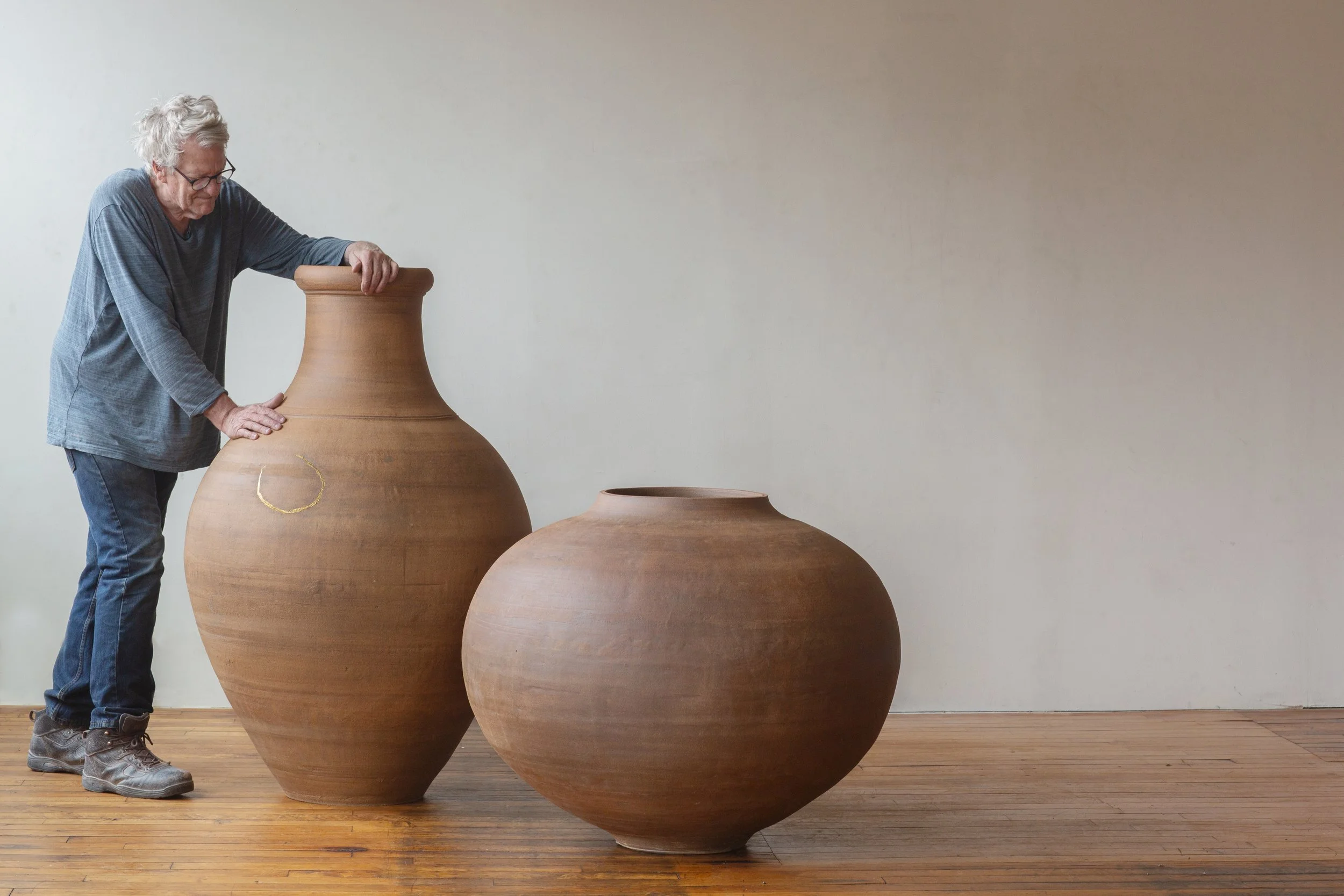
This year, my work is featured at the Berkshire Botanical Garden, where my ceramic vessels are thoughtfully placed among the blooms and landscapes of the garden. The exhibition is open daily from 9 a.m. to 5 p.m. through October. I’m delighted to share an interview I recently had with the Garden about my vessels, my creative philosophy, and the quiet dialogue between sculpture and nature.
We couldn’t help but to notice your exhibition title: It is both bold and poetic. What makes a vessel a “grand gesture” in a garden?
Great Question! “Grand gesture” immediately brings to mind largeness, but scale, per se, doesn’t satisfy. More important is the inspiration that motivates and justifies the scale — the animating impulse often includes some mixture of generosity, expansiveness, gratitude, compassion, awe, and love. If the piece is successful, when I look at it I will be reminded of the feelings that inspired it. Yes, it should please the eye, but it must also speak to the gut and the psyche.
Your vessels can weigh 250 pounds and stand five feet tall. Do you ever think, “Well … that escalated quickly”?
Ha! Yes, from time to time a piece takes on a life of its own and goes in directions that I did not anticipate. Usually the result is something extraordinary that I would not have dared, although sometimes it’s a dead end. Fortunately, there are some built-in limitations: Clay simply does not do some things, and I cannot fit anything taller than 6 feet into my kiln! In any case, nothing happens quickly at this scale. The pace is always methodical and meditative. So it escalates slowly!
You’ve described your work as bridging the “seen and unseen worlds.” When your vessels are placed among living plants and shifting light, what invisible qualities are you hoping visitors will sense?
I sometimes describe my practice as a long-term investigation into the mystery of form. Why is it that a particular gesture of curve and volume should evoke awe, another one tears and yet a similar one laughter? Are the vessels transducing ethereal energies? Or does their resonance awaken something latent in the viewer? I suspect that both forces are at play — invocation and evocation. And the context of nature is significant, even essential. The garden is a place of quiet and sanctuary, a sacred space where subtle communication and inner experience can be discerned and integrated.
Some clients and viewers hug your pots, speak to them, even give them personal pronouns. What do you make of that deep emotional response, and if your vessels could talk back, what do you imagine they’d say?
I think that the potency of the pots is due to the fact that their “language” is non-verbal. Their mode of communication bypasses the realm of the intellect and goes directly to something deeper. I do think that scale has something to do with their impact: Extraordinary scale is momentarily disorienting. Without reference to something familiar, the viewer is invited to engage with the vessel on its own terms. That kind of moment is rare and bracing and often emotionally vulnerable. But if you insist on words, they might be, “Be here now. I am with you.”
Margaret Roach’s 2024 feature on you in The New York Times highlighted that monumental pots are structural elements, not accessories. What has to shift in a gardener’s mindset?
The first shift is to think “sculpture,” not “pot.” They can create a focal point, anchor a bed, announce a transition, lead a visitor, or create a visual destination. In every case they reinforce the bones of the garden while imparting elevation and grandeur. The second shift is understanding the material: high-fire stoneware is impervious to moisture and withstands freezing temperatures, so the vessels provide presence through all seasons, sometimes more dramatic in winter.
This summer, your ceramics mingle with peonies, pollinators, and the full bloom cycle. How do they behave outdoors versus in a gallery?
Oh, my goodness, so different! The gallery is static. In the garden the vessels are constantly changing. The surfaces, even unglazed, subtly reflect light. Shadows of leaves play on them, they shine in rain, “wear” snow playfully, and take on moss patina over time.
Many of your forms are inspired by seed pods, cocoons, and hives. Are they botanical companions, architectural anchors, or something more mysterious?
I see my vessels as all those things! I love the curves of plants and animals, and we all have absorbed ancient Mediterranean pot forms. My pieces seek to harmoniously reconcile these influences, suggesting, for instance, a pregnant belly while embodying classical proportion. My aim is not replication, but a synthesis that feels at home in nature.
Your surfaces are simple — no flashy glazes. Are your vessels the calm, quiet guest at the garden party?
Before I was seduced by clay in mid-life, I was a classical guitarist. I do not have the personality of a soloist, and what I loved and did best was playing chamber music and accompanying. My musical temperament seems to have carried over into my life as a ceramicist. I want my pieces to be a co-equal participants in the conversation, ready to step forward when called for, ready to support and elevate when needed, but always a steady presence. Calm and quiet guest? Perhaps, but no wallflower!
You’ve said a large vessel can act as a greeter. What welcome do your pots offer at BBG?
At the BBG entry I hope to evoke a big wow. By the pond I hope to create a quieter, more reflective moment. As visitors approach a new garden “room,” I hope to provoke excitement, and peeking through a grove of trees, curiosity.
After all the time you spend on these pieces — three weeks shaping, drying, firing — placing a vessel in the landscape must feel like a parent on the first day of school. True?
Ha! In your three weeks calculation you forget the 30 years figuring out how to do it! Yes, I am always hopeful (and a little anxious) that the piece will be well received. It is not uncommon that we discover once the actual piece is on site that it belongs in a slightly different location than we thought. Once set, everyone knows it instinctively and without hesitation. We set it down, and so often someone in the party exclaims words I love to hear: “It looks like it has always been here!”